
Unlocking the Jaw: How Biodynamic Craniosacral Therapy Can Bring Relief to TMJ
You wake up and your jaw already aches. Maybe your temples are tight, there's that familiar clicking when you open your mouth, or you've been told you grind your teeth at night — a habit you have no memory of and no idea how to stop. You've tried the night guard. Maybe you've had adjustments or physical therapy. And yet here you are, still clenching, still aching, still wondering why your body won't just let go.
I want you to know something: your jaw is not the problem. It's the messenger.
And when we learn to listen to what it's saying — really listen, at the level of the whole system — that's when things begin to change.
TMJ Is Not Just a Jaw Issue
The temporomandibular joints are two of the most frequently used joints in the entire body, and two of the most neurologically rich — surrounded by muscles, nerves, and connective tissue that connects directly to the cranium, the cervical spine, and the central nervous system.
What happens in the jaw doesn't stay in the jaw. The ripple effects are wide-ranging:
Chronic headaches and migraines
Ear pain, fullness, or ringing (tinnitus)
Neck and shoulder tightness that never fully releases
Dizziness or a sense of imbalance
Facial pain or numbness
Brain fog and disrupted sleep
Tooth sensitivity without dental cause
These are not separate, unrelated complaints. They are a system speaking — loudly and persistently — about a pattern of tension that has likely been building for a long time.
The Jaw and the Cranium Are One Conversation
The temporomandibular joint sits directly adjacent to the temporal bones — the bones on the sides of your skull that house your inner ear and several major cranial nerves. When the jaw is restricted, the temporal bones feel it. And when the temporal bones are compressed — from old injuries, dental procedures, or chronic tension — the jaw feels that too.
Running through the center of the cranium is the sphenoid bone, the "keystone" of the skull, which articulates with nearly every other cranial bone. Chronic jaw tension almost always involves the sphenoid — and when it's restricted, the effects ripple throughout the entire craniosacral system, all the way down to the sacrum.
This is why treating the jaw in isolation so often brings only partial relief. The jaw is one voice in a much larger conversation — and BCST is designed to listen to all of it.
Why Is the Jaw Holding So Much Tension?
The jaw doesn't clench for no reason. The body doesn't grind its teeth out of nowhere. These are deeply intelligent adaptations that developed in response to something.
The jaw is one of the primary places the body stores unresolved stress and trauma. Clenching is one of the body's most ancient bracing responses — a preparation for fight, for endurance, for getting through something hard. When stress is chronic and the nervous system never fully comes out of activation, the jaw stays braced. Over months and years, that bracing becomes a pattern the body no longer knows how to undo on its own.
BCST addresses both: the physical restrictions in the bones, tissues, and fluid, and the nervous system patterns that are keeping the whole thing locked in place.
"The Craniosacral Therapist supports the body in releasing restrictions that it has been unable
to address on its own — allowing it to tell her how to proceed."
How BCST Works With TMJ
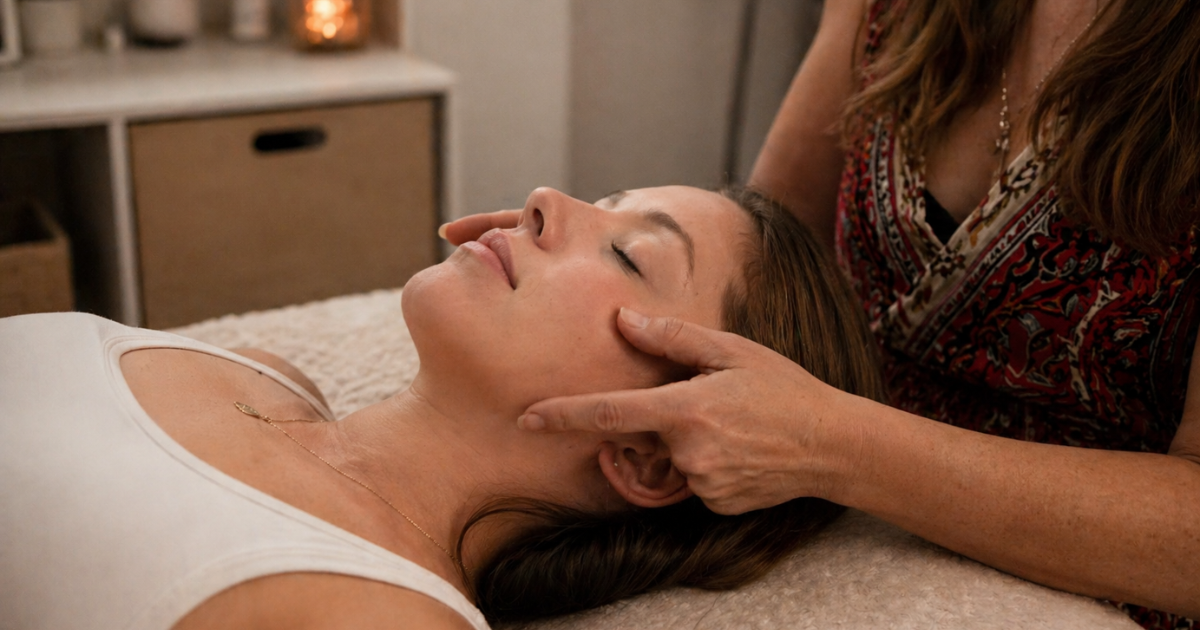
Using a touch no heavier than the weight of a nickel, I listen to the rhythms of your craniosacral system — the subtle motion of your cranial bones, the flow of cerebrospinal fluid, the state of the membranes and tissues throughout your head, neck, and spine. Within that listening, I feel the specific pattern your system is holding and gently support it in releasing.
For TMJ specifically, this often involves:
Working Intra-orally — this requires working inside the mouth to address the medial and lateral Pterygoids, the palate/roof of the mouth, floor of the mouth, deep masseter, temporalis tendon, and deep buccinator. (This work is done very gently, with gloves, and involves no pain)
The temporal bones — releasing compression to give the jaw joint room to find its natural alignment
The sphenoid — when this central cranial bone releases, clients often feel an immediate sense of spaciousness throughout the entire head
The occiput and upper cervical spine — compression here affects cranial nerve function and overall nervous system tone, both of which directly influence jaw holding patterns
The nervous system itself — when the system feels truly safe at a physiological level, the jaw begins to let go in a way that no amount of willpower or nighttime appliances can achieve
The supra and infra Hyoid Muscles and Bone — Releasing these muscles often decreases tension in the neck, and tongue and have a fascial connection that can be felt all the way down to the big toes!
Many clients notice during the session that the jaw begins to soften and drop, almost involuntarily. Yawning is extremely common — and very welcome. It's the jaw doing spontaneously what it has been trying to do for a long time: release.
"I've Had a Night Guard for Years. Why Isn't It Enough?"
A night guard protects your teeth — and that matters. But it doesn't address why the grinding is happening. It manages the consequence without touching the cause.
BCST works on the cause. By releasing the physical restrictions and nervous system patterns driving the clenching, we're not just catching symptoms — we're creating the conditions for the pattern itself to change. Many clients find that when the deeper restrictions are addressed, everything else they've been doing starts working better too.
You Don't Have to Live Like This
If you've been managing TMJ pain for months or years — adjusting what you eat, waking with a sore jaw, quietly dreading the click and the ache — I want you to hear this:
You don't have to keep managing. There may be a way through.
Your body is not broken. It is holding a pattern it developed for very good reasons, and it is waiting — with extraordinary patience — for the right conditions to let it go. BCST creates those conditions. Gently. Without force. At your body's own pace and in its own order.
That is the work I get to do every day. And it is one of the greatest privileges of my life.
Ready to give your jaw — and your whole system — a chance to finally let go?
Book a session at cranialjones.com · 720-312-4627 · cathy@cranialjones.com
7425 E. Peakview Avenue, Building #10, Centennial, CO 80111 · Open by appointment only